Whether you have started a new business or are running an existing one, you do want to know how long it will take for SEO to rank and start performing.
You can expect 4-6 months to start noticing changes, and a positive ranking state in about 10-12 months. It may take a bit less or more, depending on the level of competition and the SEO effort.
Example: A local plumber in a regional suburb and a national finance brand are operating in entirely different competitive environments. The timing will vary significantly.

In this guide, you will learn about the SEO ranking timeline, factors that impact the ranking, and things you can do to improve, including making your SEO effort accountable.
Table of contents:
- SEO Ranking Timeline
- Timing By Industry
- Timeline Factors
- SEO Monthly Timeline
- Is Your SEO Working?
- How to Speed Up?
- Get Professional Help
- FAQs
SEO Ranking Timeline
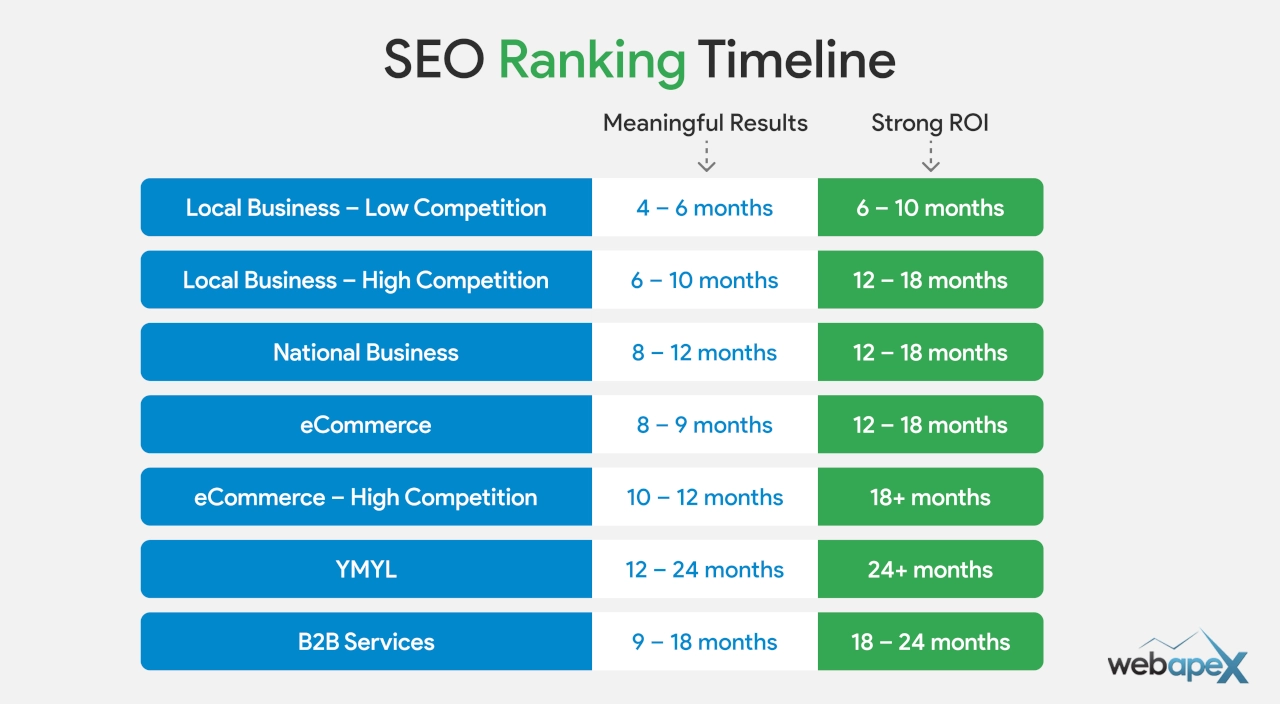
| Business Type | Meaningful Results | Strong ROI |
| Local Business – Low Competition | 4 – 6 months | 6 – 10 months |
| Local Business – High Competition | 6 – 10 months | 12 – 18 months |
| National Business | 8 – 12 months | 12 – 18 months |
| eCommerce | 8 – 9 months | 12 – 18 months |
| eCommerce – High Competition | 10 – 12 months | 18+ months |
| YMYL (Your Money or Your Life)
E.g. Finance, Legal, Health, Medical, Insurance, etc. |
12 – 24 months | 24+ months |
| B2B Services | 9 – 18 months | 18 – 24 months |
These timelines are based on our experience working across different business types. Domain age, site health, and the consistency of your SEO effort will shift these numbers in either direction.
Consider the above SEO timeline as a general guide only, based on our experience working. They vary significantly based on the level of SEO effort and SEO ranking factors.
Your SEO Budget Shapes Your Timeline
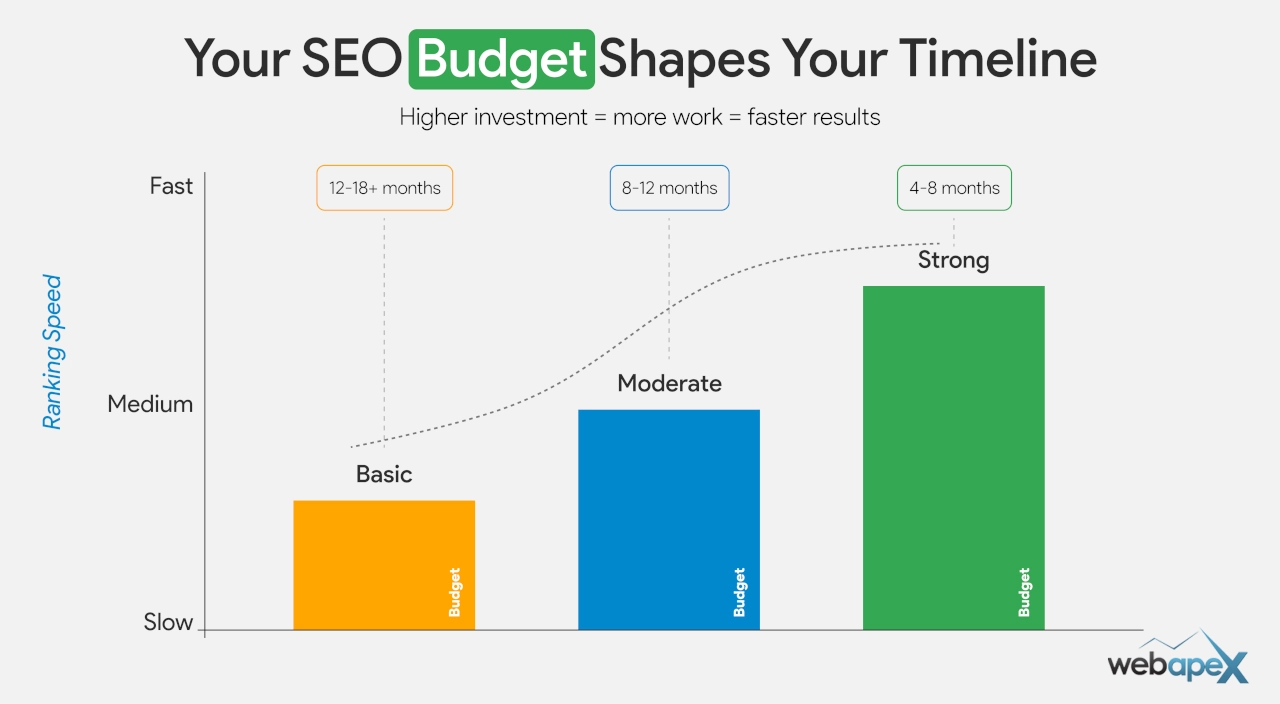
The level of SEO work that will be carried out on a regular basis will impact your ranking timeline greatly. It is important to note that SEO ranking is impacted by many factors, which are discussed below.
By choosing the right SEO package, you can focus on what matters the most, like building high-quality content, brand SEO, link building, technical SEO and more.
The budget that works for a local business will not do justice to a national eCommerce store; the investment needs to match the competition you are up against.
So, choose your SEO package wisely, visit the SEO cost in Australia page where you can learn in detail about the packages, inclusions and expected timeline.
SEO Ranking Timeline by Industry
The timelines below are based on our experience across industries. Use this as a directional guide for your planning. Talk to us for your specific needs.
| Industry | Examples | Competition | Meaningful Results |
| Home and Garden Services | Plumbing, HVAC, landscaping, cleaning, pest control | Low to Medium (local) | 4 – 6 months |
| Trades and Construction | Builders, electricians, roofers, painters | Low to Medium (local) | 4 – 6 months |
| Creative and Personal Services | Beauty salons, photographers, personal trainers, coaches | Low to Medium | 4 – 6 months |
| Hospitality and Tourism | Restaurants, hotels, travel agencies, tour operators | Medium | 4 – 8 months |
| Automotive | Car dealerships, mechanics, auto parts, panel beaters | Medium to High (local) | 4 – 9 months |
| Education and Training | Schools, colleges, tutoring centres, online courses | Medium | 6 – 12 months |
| Medical and Dental Clinics | GPs, dentists, specialists, chiro, physio | High (E-E-A-T) | 6 – 12 months |
| Retail and eCommerce | Clothing, electronics, skincare, garden products | Medium to High | 6 – 12 months |
| B2B Services | SaaS, Consultants, agencies, IT services, manufacturers | Medium to High | 9 – 18 months |
| Financial and Professional Services | Financial advisors, mortgage brokers, legal, real estate | Very High | 9 – 18 months |
| YMYL (Your Money or Your Life: finance, legal, health, medical at national scale) | Insurance, investment platforms, national health networks | Extremely High | 12 – 24 months |
These are meaningful results timelines, not strong ROI. Every number assumes consistent, quality SEO work is in place.
Factors That Determine Your SEO Timeline
The table above gives you a starting point. These factors explain why one business takes 6 months, and another takes 12-18 months.
Note that I have listed core factors below only; there are many more.
Competition in Your Niche
Competition is one of the biggest drivers of your SEO ranking timeline.
Example:
- A florist targeting “florist Melbourne CBD” competes against a few of the local websites.
- A mortgage expert targeting “mortgage broker Melbourne” competes against major banks, national brokers, and comparison platforms with years of SEO investment behind them and a significantly higher budget.
If you are in a competitive niche, don’t settle for an ordinary or low-budget strategy. Do your due diligence, research and invest wisely if you are serious about getting quality SEO results.
New vs Aged Domain
It is easier to rank an aged, trusted domain with a clean history than a brand-new domain. It is not just because of the age alone, but older domains have accumulated the trust signals that new domains need time to acquire.
A new domain goes through Google’s sandbox period, which typically adds 3 to 6 months to your ranking timeline while that trust is being established.
Keyword Difficulty and Search Volume
Keywords with high search volume and generic in nature require a much greater effort to rank than long tail keywords with less competition.
If you just focus on high competition keywords, then you are missing out on opportunities that are easier to rank.
A diversified keyword approach, mixing high-intent long-tail terms with broader targets, produces faster early results and builds toward harder terms over time.
Content – Quality vs Quantity
Well-researched, detailed content will always outperform thin content. This is even more important now, considering anyone can publish content using AI.
Producing quality content takes time and money, but it can add much greater value in the long run.
Topical authority builds when your site covers a subject comprehensively, addressing the core and pillar topics.
Pick an SEO package that includes quality content production to add real value.
Backlinks and Domain Authority
You may have the best content, but if you lack domain authority, then you may struggle to rank higher with consistency.
Linkbuilding is one of the most difficult and expensive tasks to get right. But if done well, then it can help the SEO ranking greatly.
Link building typically takes around 3 months to show noticeable ranking improvements once acquisition begins, according to industry surveys of SEO professionals.
Website and Content Structure
A good website structure helps users as well as search engines to find and navigate through the pages. It is the foundation of crawling and indexing.
A good website structure includes navigation, URL, and breadcrumb planning. A poorly structured website can use more crawl budget, and the impact grows significantly as the site scales in page count.

Technical SEO
Technical SEO can hurt SEO fast, and the solution can also be implemented with speed. Fixes can also show results quicker than most other SEO work, often within 2 to 6 weeks.
Brand Signals
The brand SEO signal is more important than ever before. Search engines like Google like to rank a real brand over some new random website, even with good content and website health.
Month-by-Month SEO Timeline: What to Expect
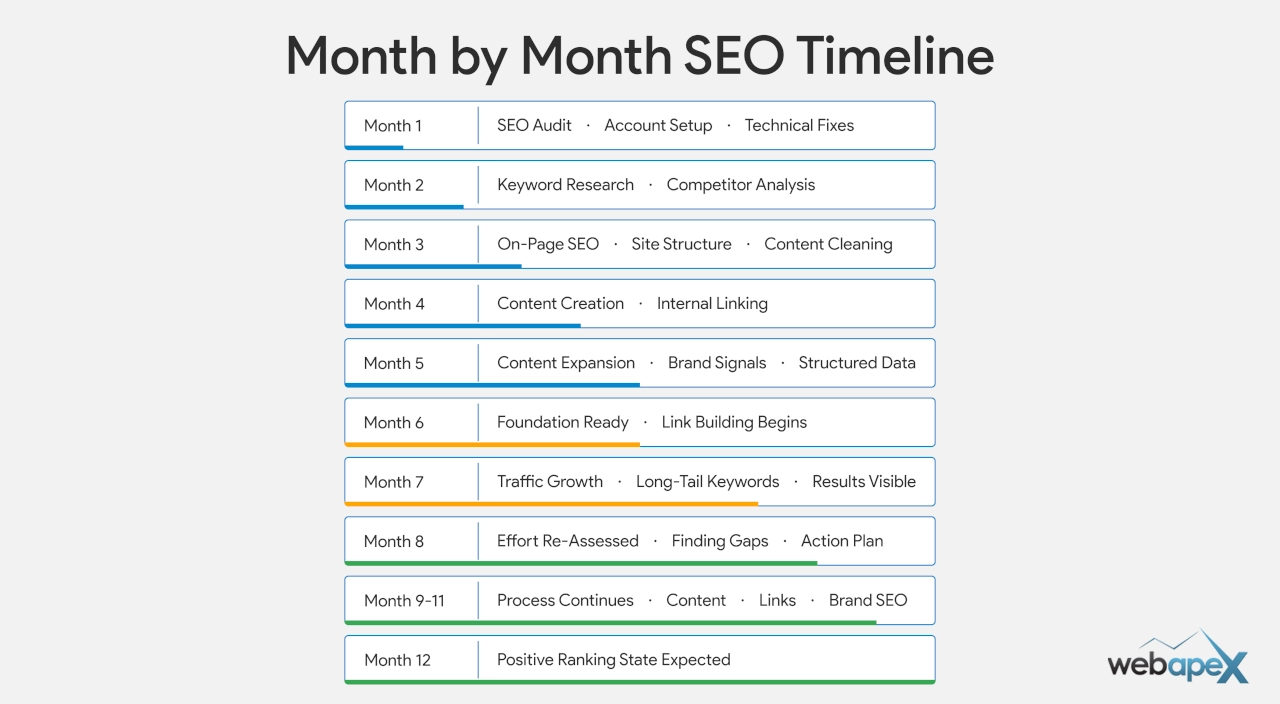
Month 1: SEO Audit · Account Setup · Technical Fixes
When an SEO campaign starts, there are several setups that need to be done if not already in place, like setting up Google Search Console (GSC), Google Analytics 4, and third-party analytics and tracking tools.
For existing businesses, these setups need to be checked and verified.
A thorough SEO audit is also carried out to check the overall health of the website, and technical fixes begin as they are generally quicker to fix.
Month 2: Keyword Research · Competitor Analysis
Research is the foundation of quality work in marketing, and SEO is no different. SEO is driven by keywords, as that is what users type to search on Google and other search engines. Keyword research includes finding primary and secondary keywords to satisfy business needs and goals.
Competitor analysis is also carried out, as this guides the level of competition the strategy should be designed against. Having a clear understanding of the competition early on forces you to stay competitive from the get-go.
A thorough competitor analysis also gives an idea about how long SEO may take to rank.
Month 3: On-Page SEO · Site Structure · Content Cleaning
This is where you will start to see the real difference visually, as it will include addressing on-site SEO issues, fixing or improving the website structure for better user experience and crawlability.
The process also includes content cleaning to merge/delete thin content pages, and making improvements on those that are already performing well.
Month 4: Content Creation · Internal Linking
Content creation and internal linking are among the most important aspects of SEO that will help with ranking increases.
It is not about producing random content. It is about producing content with pre-conceived ideas and proper internal linking to help with SEO ranking.
Producing quality content eg. building linkable assets takes time and iterations. If you are in a competitive niche, the effort required will be of an even higher scale, so be prepared that SEO takes time to work.
Month 5: Content Expansion · Brand Signals · Structured Data
This is the time to pass even stronger signals to Google by building better topical authority with content expansion. A strong brand signal is key, as search engines like Google do not want to rank random websites, instead rewarding those that are trusted and carry strong brand signals.
One of the ways to pass critical metadata is by using structured data to display reviews, pricing, shipping costs, and other information to make the listing stronger and boost the click-through rate (CTR).
Month 6: Foundation Ready · Linkbuilding Begins
It is important to get the foundation right, as the next process of building links will add much greater value to ranking when the website architecture is right, the website has clean and quality content, and technical SEO is taken care of.
Link building is one of the most difficult tasks, acquiring relevant links that will add real value, but if done well, it can boost rankings significantly.
This is a major ranking factor, and it is not easy. It takes time and persistence, and consider this when thinking about the SEO timeline.
Month 7: Traffic Growth · Long-Tail Keywords · Results Visible
Ideally, you should start to notice ranking changes by now, with early contributions visible from month 6.
You may notice your long-tail keywords starting to rank, including blog posts and some core money pages showing ranking changes. It is still too early for highly competitive niches to notice a decent difference, but the process should continue.
This is the time to document where things started and what kind of difference has been noticed with the effort put in so far.
Month 8: Effort Re-Assessed · Finding Gaps · Action Plan
This is the time to reassess the strategy based on the ranking outcomes noticed, to find the gaps and prepare the next action plan.
While the core strategy will remain the same, identifying the real gaps and planning the efforts to fill them will make a real difference from here on.
Month 9 – 11: Process Continues · Content · Links · Brand SEO
The process continues, building quality content, acquiring new links, and maintaining stronger brand signals while filling the gaps between where you stand and where your competition is.
Sometimes it may feel like not winning as the results are not reflecting the effort in the same manner, but persistence is key here. Continue to build, and the difference will be noticeable.
Month 12: Positive Ranking State Expected
You should expect a positive ranking state around month 12, meaning the effort should reflect into real business with more leads or sales.
If not realised, then at least you should compare where you started and how far you have come. If the answer is positive, then continue.
If the outcome is not satisfactory, you may seek an alternate opinion.
Note: In a competitive niche, a 12-month period may still not be enough to see a significant difference, but it is worth re-assessing.
How to Know If Your SEO Is Working
Traffic growth is the most visible sign of SEO working. But there is more than just traffic growth to learn whether it’s working or not.
Here is what to look for:
- Traffic Increase: When you notice traffic is increasing, and if the SEO is done in the right manner, then you can say it’s working.
- Impressions Increase: If you notice only minor improvements in traffic and ranking, then it’s worth checking if the effort is translating into an impression increase. Impression increase reflects that more effort is required to boost ranking and traffic.
- Noticing Website Changes: SEO effort includes fixing website structure, navigation, building quality content, and removing thin content pages. This is the path to success.
- Average Position Improvement: A page moving from position 45 to 18 shows zero clicks but real progress. Track average position by page, not just site-wide.
- Branded Search Volume Increasing: More people searching for your business by name is a direct trust signal to Google. Growing branded queries tells you real authority is being built.
The sequence is always the same: impressions, rankings, clicks, conversions. If the first two are moving, the rest follows.
How to Speed Up Your SEO Rankings
If you want to speed up your SEO ranking timeline, then think about two main things: 1) Get a real competition assessment, and 2) Invest in SEO strongly.
As covered above, your budget shapes your timeline directly; more investment means publishing high-quality content regularly, faster technical fixes, and the effort to build quality links.
Strategy-wise, here are the key things that impact the SEO timeline:
- Fix Technical Issues First: Technical SEO impacts crawling and indexing, which directly impacts your rankability. It includes indexing related items (robots.txt, noindex, canonical, etc.), Core Web Vitals, website availability, server response codes and more.
- Quality Content: This is the foundation of a strong SEO plan. Don’t settle for ordinary content.
- Keywords Target: Don’t just target highly competitive keywords; have a diversified approach to include primary and secondary, including long tail keywords, for a broader outcome.
- Brand SEO: Take your brand seriously; an ordinary website with no brand trust will struggle to rank. Invest in your brand.
- User-Generated Content: This indicates that users love what you have to offer and provides freshness to your SEO efforts.
- Link Building: One of the most powerful strategies that can boost the ranking fast.
- Stay Consistent: The biggest cause of a slow SEO timeline is inconsistency. Gaps in content production, paused link building, and delayed technical fixes all add months to the outcome.
There is no shortcut to sustainable rankings. It requires time, money and energy.
Get Professional Help with SEO Timing Assessment
You now know the realistic timeline, the factors that shape it, and what to expect month by month. The next question is where your business actually sits within it.
That depends on your current SEO health, your competition, and your budget, and no blog post can answer that for you.
The team at webapex is here to answer that for you.
We have worked with businesses across Australia, building a realistic SEO ranking timeframe and month-by-month plans.
We can build the same kind of plan for your business. Visit our SEO case study and our SEO services page to learn more.
FAQs
How long does local SEO take to work?
Low competition local businesses typically see meaningful results in 4 to 6 months, with high competition local markets taking 6 to 10 months. Google Business Profile optimisation with user-generated key and brand signals is key here.
How long does an eCommerce website take to rank?
You can expect an eCommerce website to rank in 8-12 months. You may see improvements early but noticeable changes can be expected post 6 months and a good ranking state in 12-18 months.
How long does SEO take for a new website (brand new domain)?
New domains go through Google's sandbox period, adding roughly 3 to 6 months before rankings reflect the work being done. The good news is that this time is not wasted if the foundation work is done right.
How many hours of SEO work are required per month to rank?
It depends entirely on your competition. For a low competition business, 10-15 hours of work per month can add good value. In a competitive niche, you may need 30-50+ hours of SEO work per month.
Why does SEO take a long time to rank?
Google needs to crawl, index, and build trust in your site, and trust is earned through accumulated signals like content, links, and engagement over time. None of this can be skipped, so it takes time to rank.
How does a Google core update affect my SEO timeline?
A core update can pause progress for a cycle while Google re-evaluates the web, even if your site has done nothing wrong. Recovery typically aligns with the next update cycle.
Is 12 months realistic for every business, or could it take longer?
Twelve months is realistic for meaningful results in most industries, but it is a benchmark, not a guarantee. Highly competitive niches can take considerably longer, as shown in the tables above.

