
Google Ranking Dropped - #1 Fix
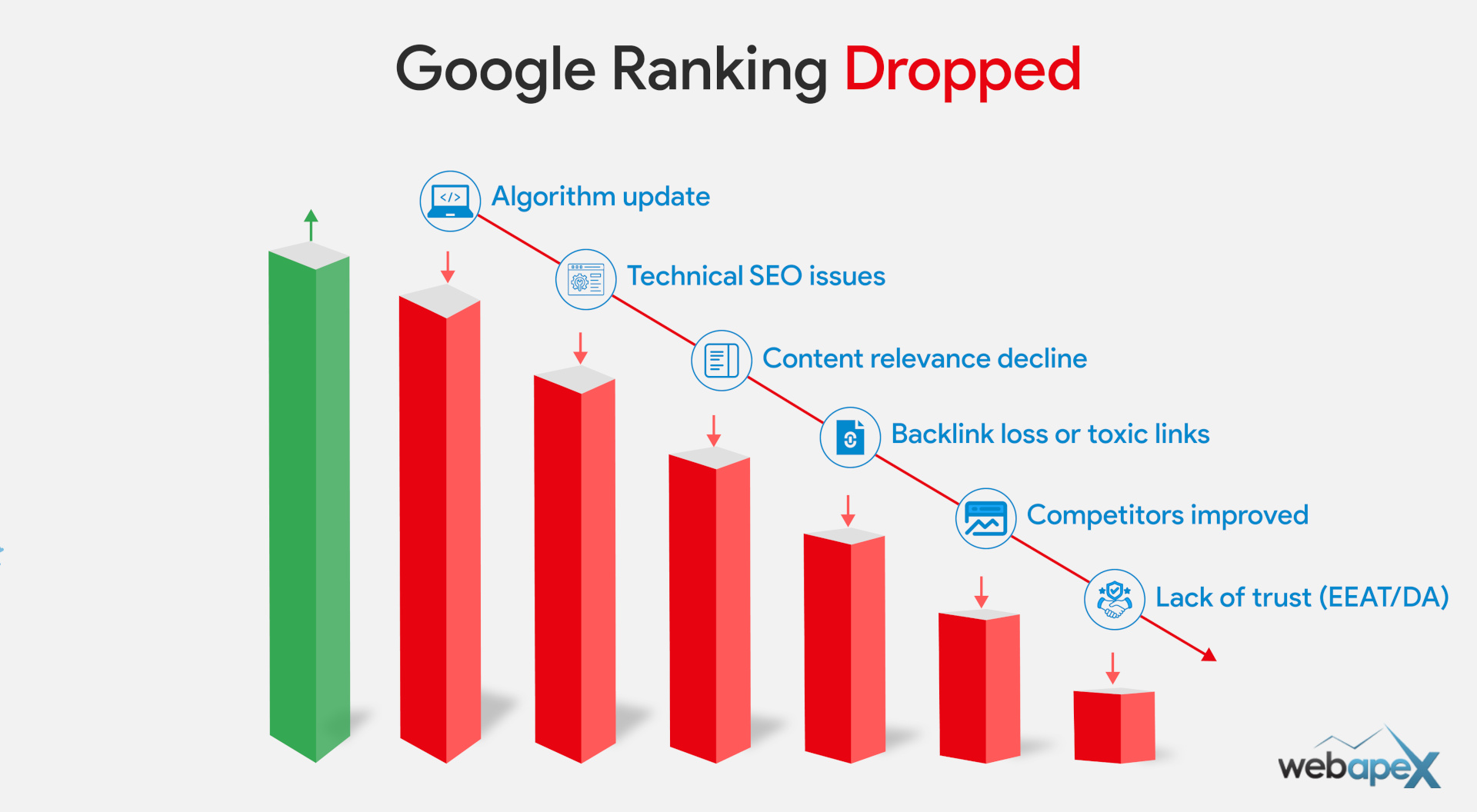
A Google ranking drop overnight is one of the most stressful things that can happen to a business that depends on search traffic. It can happen due to various reasons like: a technical SEO issue, an algorithm update, backlink loss, or content relevance decline. The good news: most drops are recoverable.
Don't Panic
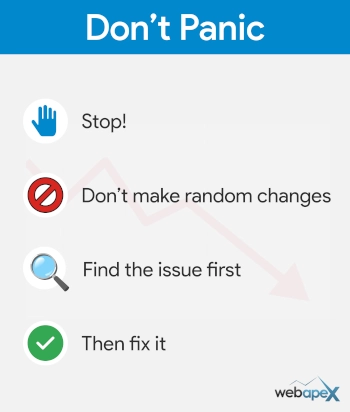
It may not be as bad as it looks.
Before you make random changes, stay calm and investigate the root cause first.
Minor ranking fluctuations are completely normal. Google runs hundreds of algorithm experiments every year, and your website will be tested against those. This volatility resolves on its own within days.
A sudden Google ranking drop reflects major issues, such as the website not being accessible (403 or 404 errors) to Google bots or a significant algorithm update affecting the site, whereas a gradual ranking drop is typically caused by content gaps between you and competitors, backlink decay, or a lack of trust and brand signals.
The rule is simple: confirm the drop is real before acting. Check Google Search Console (GSC) and Google Analytics (GA4). If both show a consistent decline over 5-7 days, you have a problem worth diagnosing.
The next section is a detailed troubleshooting guide that you can refer to.
SEO Ranking Drop Troubleshooting Checklist
Here is the SEO ranking drop checklist that you can follow to troubleshoot.
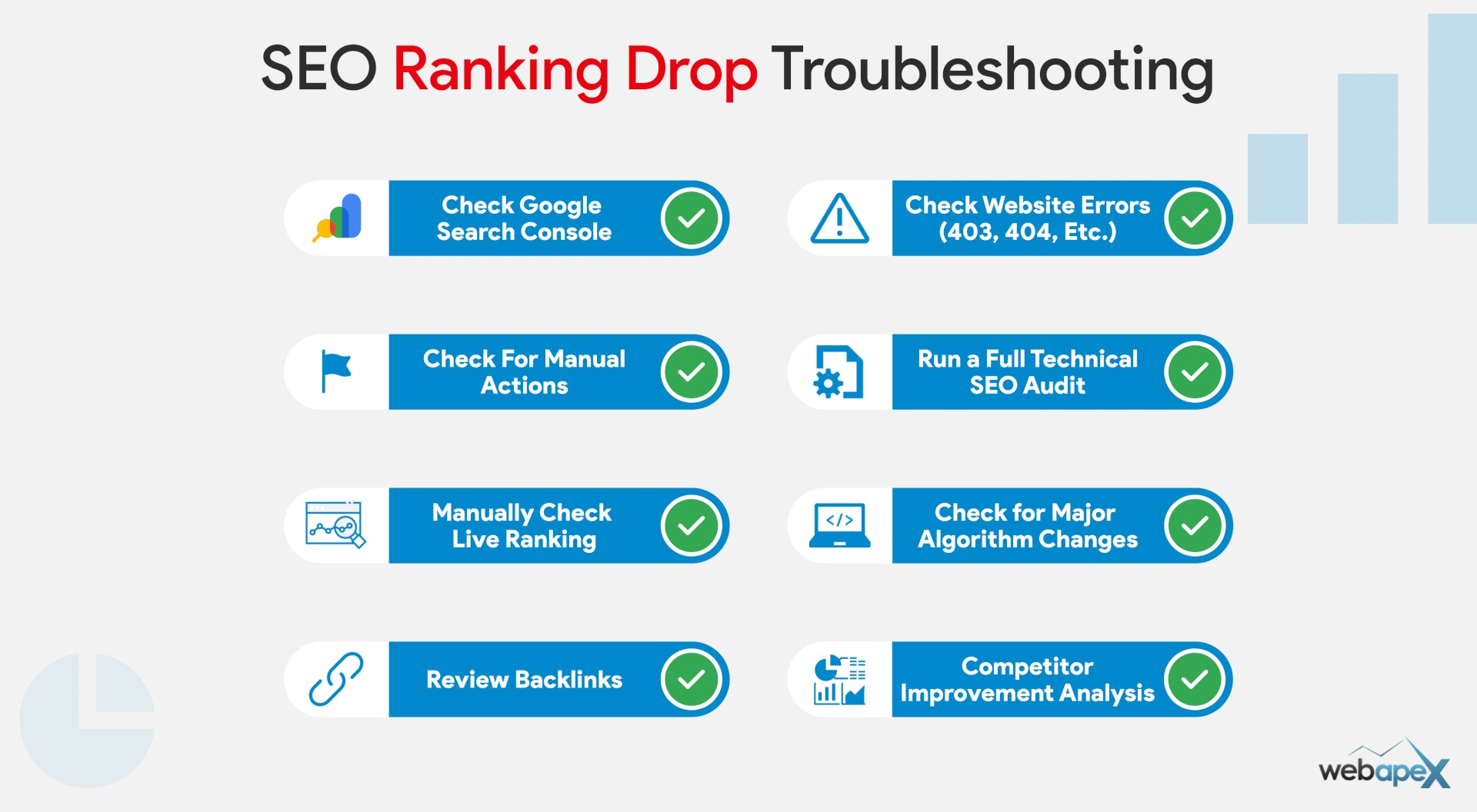
1. Check Google Search Console
Google Search Console (GSC) is the first place to look. It shows you what Google actually served to real users, not what a third-party tool estimates.
Go to Performance ⟶ Search Results. Set the date range to last 3 months and see clicks and impressions decline.
|
Pattern |
What it likely means |
|
Both clicks and impressions dropped |
Rankings fell, you're appearing less often in results |
|
Drop on mobile only |
Mobile usability or Core Web Vitals issue |
|
Drop on specific pages only |
Content gap, intent, or on-page issue |
|
Site-wide drop across all pages across devices |
Algorithm update, penalty, or major technical issue |
Find out when exactly the drop started and the specifics.
2. Check for a Manual Action
A manual penalty is rare, but it's the most severe cause of a ranking drop. Google's human reviewers issue these when your site violates their spam policies, and unlike algorithm hits, they don't resolve on their own.
Go to GSC ⟶ Security & Manual Actions ⟶ Manual Actions. If there's a penalty listed, it will tell you the details, for example:
- Unnatural links to your site
- Pure spam
- Cloaking and/or sneaky redirects
- etc
If you have a manual action, stop here and treat this as serious. Fix the specific violation, then submit a reconsideration request through GSC. Recovery typically takes 2-4 weeks after the request is reviewed.

3. Manually Check Your Live Rankings
Don't rely solely on tools. Open an incognito browser window and manually search your primary and secondary keywords; this should give you a real perspective.
The incognito mode removes personalisation and gives you a clean, unfiltered view of where you actually rank.
Validate your manual findings with Google Search Console or Google Analytics data.
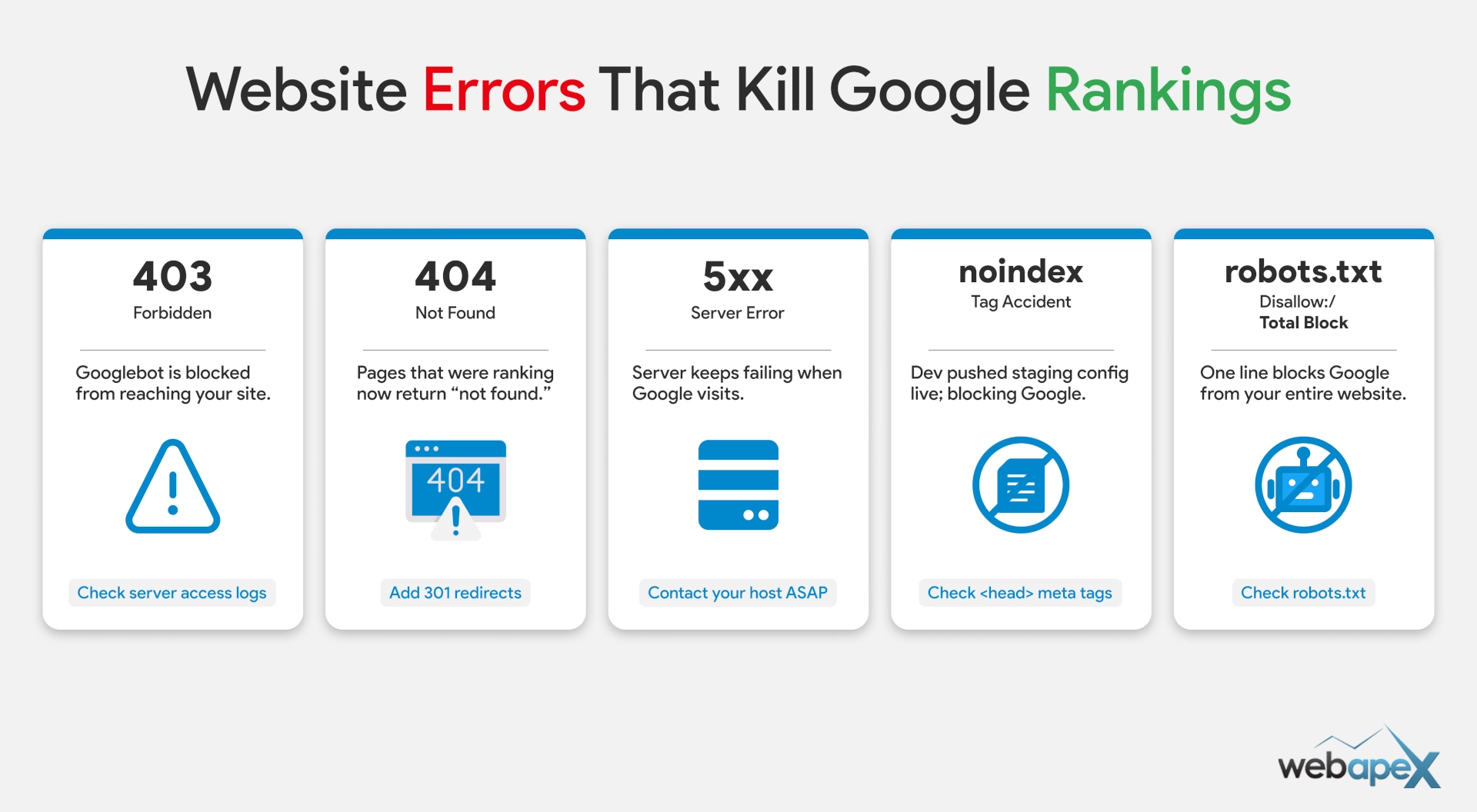
4. Check for Website Errors (403, 404, 500)
A single bad move to your website, firewall can knock your rankings down. Common issues to check for:
- 403 Errors: While it may appear all is working well for you, you need to ensure Google Bot servers can reach your website correctly. Check your website availability globally, especially common server locations like the US, UK, Singapore, etc.
- 5xx Errors: If Google hits your site and gets repeated 500 errors, it stops crawling, and rankings will drop.
- 404 Errors: Pages that were ranking now return "not found."
- Noindex Tag: Your dev team may have accidentally pushed a staging config live, and suddenly, your entire site tells Google not to index it.
- robots.txt Blocks: One line (Disallow: /) blocks Google from your whole site.
Check GSC ⟶ Pages for a list of crawl issues. Also, run your domain through third-party tools like Ahrefs or Screaming Frog.
5. Run a Full Technical SEO Audit
If the above checks don't reveal an obvious cause, run a complete technical crawl. Key things to look for:
- Duplicate content / canonical tag issues
- Broken internal links
- Redirect chains or loops
- Core Web Vitals failures (LCP, INP, CLS)
- Mobile usability issues
- Crawl budget being wasted on low-value pages

Most third-party SEO tools are capable of checking most of these issues to give you actionable items.
6. Check for a Major Algorithm Update
This is another major cause of Google ranking getting dropped overnight.
Cross-reference your drop date with Google's algorithm update history. Google publishes confirmed updates on the Google Search Status Dashboard and Google Search Central Blog.
|
Update type |
Who it targets |
|
Core Update |
Overall content quality, E-E-A-T, search intent alignment |
|
Spam Update |
Link spam, AI-generated low-value content, and manipulative tactics |
|
Helpful Content Update |
Content made for rankings rather than people |
|
Product Reviews Update |
Thin reviews without genuine experience or depth |
7. Review Your Backlinks
A sudden loss of quality backlinks or a jump in toxic links can cause a fast drop in authority and rankings.
Check Ahrefs or SEMrush for:
- Lost Links: In the last 30-60 days
- New Toxic or Spammy Links: Get your overall link profile checked.
If a high-authority site that linked to you removed the link, or a large link network you were part of got hit by a spam update, that's a direct cause worth addressing.
8. Competitor Improvement Analysis
It’s not always about your website or Google’s algorithm update.
Sometimes your rankings fall because your competitors got better. This impacts slowly, not an overnight one, but worth checking.
Keep track of your top competitors for pages that add value to your business.
You can use Ahrefs ⟶ Site Explorer ⟶ Enter your Competitor's Domain: look at their organic growth timeline. If this is true, then invest time in finding the content gap or backlink analysis.
Why SEO Ranking Drops?
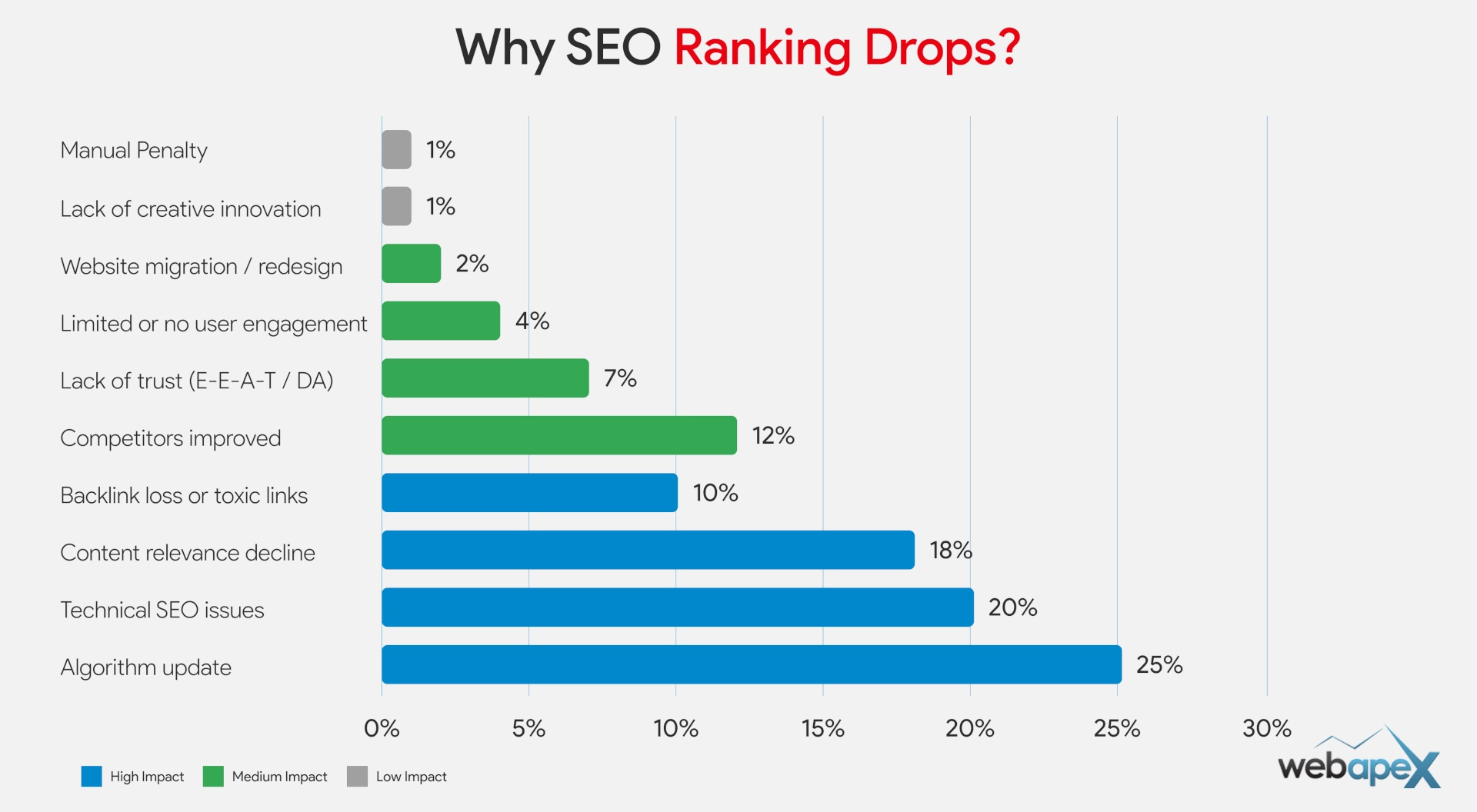
Once you have completed the troubleshooting checklist, you should have a clearer picture of the cause. Here's a breakdown of the most common reasons, from highest to lowest frequency:
|
Cause |
Frequency |
Drop Pattern |
|
Algorithm update |
25% |
Sudden, site-wide or topic-wide |
|
Technical SEO issues |
20% |
Sudden, can be specific pages or site-wide |
|
Content relevance decline |
18% |
Gradual, then sharper |
|
Competitors improved |
12% |
Gradual |
|
Backlink loss or toxic links |
10% |
Gradual or sudden |
|
Lack of trust (E-E-A-T / DA) |
7% |
Gradual |
|
Website migration / redesign |
2% |
Sudden, post-launch |
|
Lack of creative innovation |
1% |
Very gradual |
|
Manual penalty |
1% |
Sudden, severe |
The frequency estimates above are synthesised from multiple published research sources, including SE Ranking's audit of 418,000+ websites, Backlinko's analysis of 11.8 million search results (with Ahrefs data), ALM Corp's December 2025 core update study of 150+ affected websites, and Google's own ranking systems documentation. No single study publishes a unified percentage breakdown across all causes simultaneously. These figures reflect relative frequency, how often each cause appears as a primary driver, based on what the data collectively shows.
One important distinction: overnight drops are almost always technical or algorithmic. If your rankings have fallen dramatically overnight, look at technical issues first, then check for an algorithm update. Competitor improvements and content relevance issues take weeks to appear as drops; they don't happen overnight.
How to Fix a Google Ranking Drop? Step-by-Step Guide
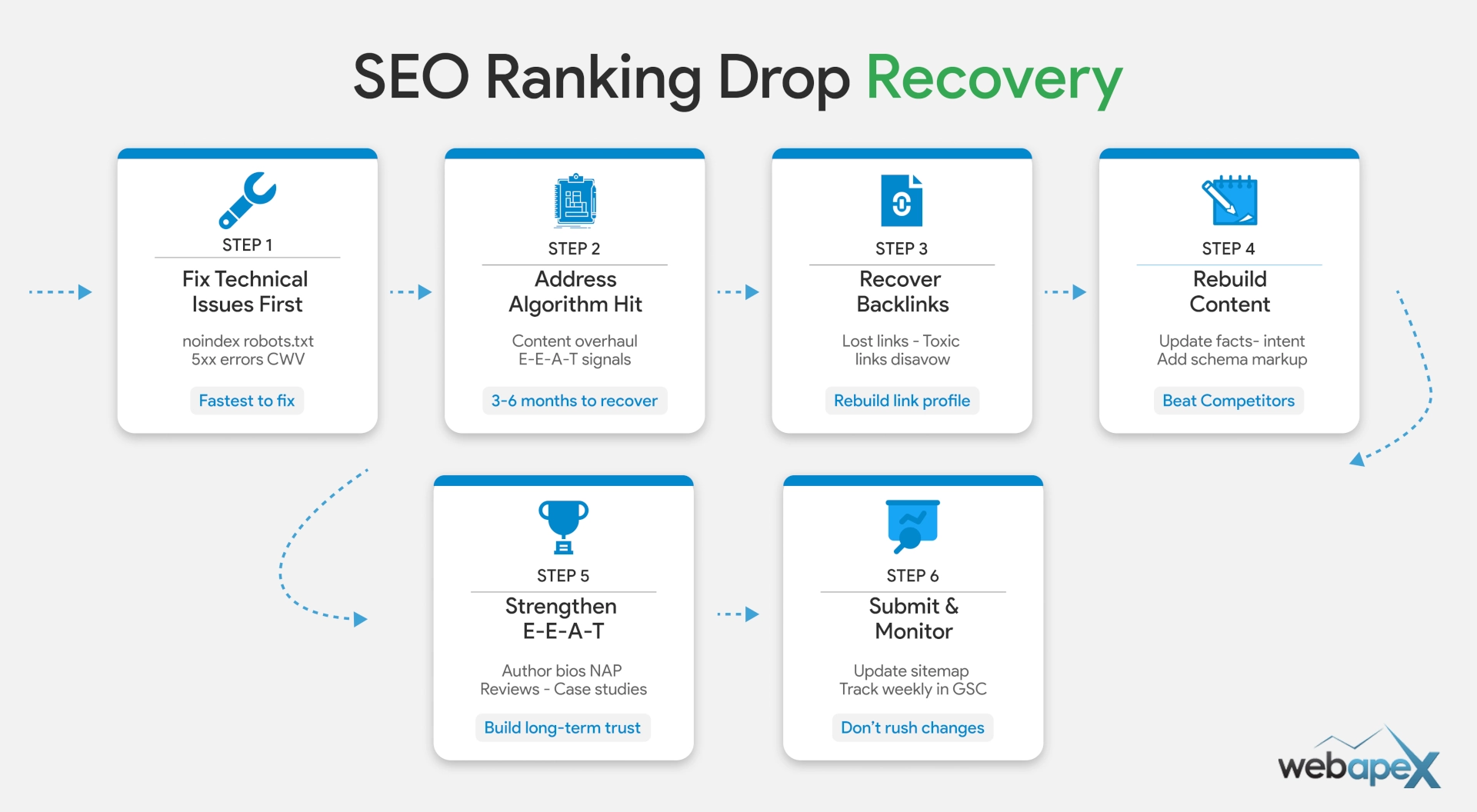
Once the cause is identified or even for a gradual drop, here's how to fix it:
Step 1: Fix Technical Issues First
Technical issues are the quickest to fix and the quickest to see results from. If your audit revealed crawl errors, indexing blocks, or broken redirects, start here.
Priority order:
- Noindex Tag: Remove any accidental noindex tags from pages that should be indexed
- Robots.txt: Fix robots.txt blocks that are preventing Googlebot from crawling important pages
- Server Errors: Resolve (5xx) with your hosting provider
- Broken Links: Fix broken internal links and redirect chains
- Core Web Vitals: Improve this, especially LCP (Largest Contentful Paint) and INP (Interaction to Next Paint), which Google actively uses as ranking signals
- Sitemap: Submit an updated sitemap via Google Search Console after fixing issues
After fixing technical issues, you may use the URL Inspection Tool in Google Search Console to request faster re-crawling of your key pages. Google doesn't re-rank overnight, but crawling the corrected pages is the first step.
Step 2: Address an Algorithm Update
If you've confirmed a core update hit, there's no quick patch. Core updates are quality re-evaluations. Google has reassessed your site's overall helpfulness, expertise, and trustworthiness relative to your competitors.
The fix is a content and authority overhaul or improvement:
Content Quality Audit:
- Identify your highest-traffic pages that lost the most rankings
- Assess whether they genuinely answer the search query better than competitors
- Update outdated statistics, examples, or information to stay relevant
- Remove thin, low-value pages (or merge them into stronger pages)
E-E-A-T Improvements:
- Add clear author bios with relevant credentials
- Include "About Us" information that establishes who is behind the content
- Get your content reviewed or quoted by recognised experts in your field
- Build brand mentions on authoritative sites
Search Intent Alignment:
- Search your target keyword in incognito mode
- Look at what type of content is ranking: is it guides, product pages, lists, or videos?
- If your page format doesn't match what's ranking, restructure it
Build Topical Authority:
- Building semantically connected content is one of the best ways to categorise content by theme, which helps you to boost relevant internal linking opportunities
Important: Core update recoveries typically take until the next core update to be recognised by Google. That means months, not weeks. Do the work now, be persistent and don’t lose hope.
Step 3: Recover Lost Backlinks and Remove Toxic Ones
Lost Backlinks:
- Identify the specific pages and domains that dropped the link using Ahrefs ⟶ Lost Backlinks
- Reach out to the linking site and ask if the removal was intentional, and request politely to restore
- If a page was removed or moved, ensure a 301 redirect is in place so link equity passes
- Rebuild through fresh content that earns links naturally, data studies, tools, original research, and in-depth guides tend to attract the most links
Toxic Backlinks:
- Export your backlink profile from Ahrefs or GSC
- Identify spammy, irrelevant, or low-quality domains linking to you
- Use Google's Disavow Tool to tell Google to ignore these links
Note: Avoid using the disavow tool unless you really need to in the case of bulk spammy links, just a few may not have a greater negative impact. Google is already good at ignoring general spam links.
Step 4: Rebuild Content Relevance
Content that ranked two years ago may no longer be relevant now. Re-assess search query and intent, see what is ranking (Image, Table, Bullet Points etc) and produce content better than your competition.
For each underperforming page:
- Update facts, figures, and data with current information
- Expand thin sections into comprehensive coverage
- Add original perspectives, case studies, or examples
- Improve formatting and readability with headers, tables, and bullet points to make content easier to scan
- Add Schema markup where relevant (FAQ, HowTo, Article, Review)
- Get an independent audit done if the page is of high stakes
Step 5: Strengthen E-E-A-T and Trust Signals
Google's emphasis on Experience, Expertise, Authoritativeness, and Trustworthiness (E-E-A-T) has increased significantly since 2023. If your site lacks clear trust signals, you're vulnerable at every core update.
Practical improvements:
- Add detailed author profiles to all content pages
- Ensure NAP (Name, Address & Phone Number) is consistent everywhere
- Build a robust contact us page with Phone, Address, Map, Emails of different departments, Social Icons, and Enquiry Form.
- Boost social signal - trust
- Publish case studies - real story of solving problems
- Have a process to get quality reviews regularly
- Display reviews and testimonials prominently
Step 6: Submit Your Sitemap and Monitor Recovery
After implementing fixes, submit your updated XML sitemap via GSC ⟶ Sitemaps. This tells Google your key pages are ready to be re-crawled.
Then monitor weekly using:
- GSC Performance: Watch for impression and click recovery
- Rank Tracker: Track keyword position changes using Google Search Console or their party tools like Ahrefs or SEMRush.
How Long SEO Ranking Drop Takes to Recover?
There is no one answer; it depends on the level of impact you have. Here is a breakdown of recovery time based on different causes:
|
Cause |
Approx. Recovery Time |
|
Technical issue (noindex, robots.txt) |
1-2 weeks |
|
Technical issue (speed, Core Web Vitals) |
2-4 weeks |
|
Algorithm update (content quality) |
3-6 months |
|
Backlink loss |
2-6 months |
|
Manual penalty |
1-3 months or never |
|
Competitor improvement |
Ongoing |
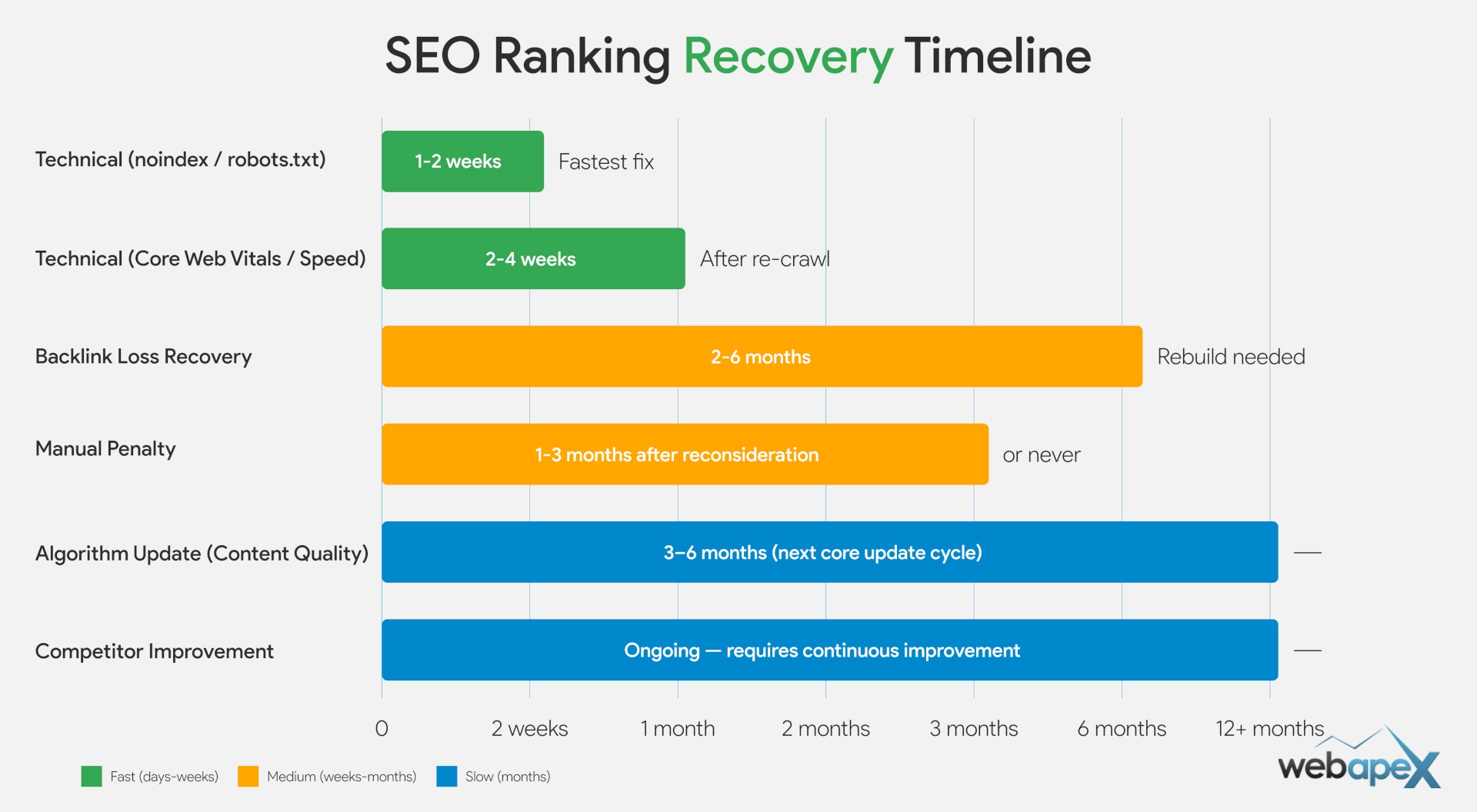
SEO ranking drop due to technical SEO issues can be fixed promptly, and hence recovery can be faster; other causes can take a much longer time.
How to Prevent a Google Ranking Drop in the Future?
Most ranking drops are preventable with consistent maintenance. Here's what to build into your ongoing SEO routine:
Ranking Tracking & Monitoring:
- Have a system in place to track and minor ranking of core business pages
- It’s best to maintain a manual system for core pages on a weekly or monthly basis
Technical SEO Health:
- Ahrefs is one of the best tools that reports any issues found on a weekly basis
- Note: Tools can’t pick up everything; you need to have a system combination of automation along with a manual approach
Quarterly SEO Health Checks:
- Full technical crawl using Ahrefs or Screaming
- Core Web Vitals review via PageSpeed Insights
- Backlink profile audit for lost or toxic links
- Content audit, including secondary pages
Build Topical Authority:
- Don't publish random blogs. Build topic clusters where supporting content links back to a central pillar page
- Indexing and information retrieval become a lot easier with semantic SEO
Stay Updated:
- Firstly, do the right things first to be almost certain that you will be the last one to get affected with algo changes
- Keep yourself updated to implement new changes as they come
Diversify Your Traffic [Don’t Just Rely on SEO]:
- Relying 100% on Google organic is a risk; even with the best of your efforts, you may lose ranking. Have other channels in place too, like Google Ads, Meta Ads, Email Marketing, etc.
Planning is everything. Don't wait for the ranking drop to happen; be proactive, work with a trusted advisor who can help you to have a more diversified marketing plan and future-proof.
Get Professional Help
An SEO ranking drop can be devastating for the business. If you don’t know what you are doing, then get a professional.
webapex is a professional SEO agency in Melbourne, helping Australian businesses with next-level SEO and consulting services.
Case Study
We have helped businesses to rank from the foundation as a new start of the business to a profitable business in 1-2 years.
We have also helped businesses to recover after an SEO ranking drop.
⟶ Check out our SEO case study to learn more about how we help clients with SEO ranking.
FAQs
How do I know if my ranking drop is from a Google update?
Cross-reference the date your rankings dropped and validate with Google’s update rollout date. Connect the dots that you had no other major changes made during that period. If the date aligns and no major changes have been made on your website, then an algorithm update is the most likely cause.
How do I know if I've received a Google manual penalty?
Go to Google Search Console ⟶ Security & Manual Actions ⟶ Manual Actions. If a penalty exists, it will be listed there with the specifics. A green tick with “No issues detected” means no manual penalty.
Is it possible to recover from a Google penalty completely?
Algorithmic penalties are generally easy to recover - You can apply changes and recover fully. In the case of a manual penalty, you can recover here too, but they are generally hard and also depend on the level of penalty; in some cases, you may never be able to recover.
Should I delete thin content that's lost its rankings?
No. Analyse the page if it is thin and of no value, then you may delete and redirect to the relevant page. But if you lost ranking due to a content gap or relevance, then you can refresh the page and let Google read the modified page.
Does a Google organic ranking drop affect my Google Ads performance?
No. They are completely separate systems. But it is important to note that a drop in organic traffic means a reduction in leads, sales and revenue. Meaning you may have to increase your ad spend to come closer to where you were with SEO and Ads combined.
How long does it take to recover after a sudden ranking drop?
It depends entirely on the cause. Technical fixes are the fastest, remove an accidental noindex tag, request re-indexing in Google Search Console, and rankings can return within 1–2 weeks. Core Web Vitals improvements typically take 2–4 weeks to be recognised after Google re-crawls your site. Other causes, like manual penalty, core algorithm impact may take 2-6 months.
How hard is it to recover from a Google manual penalty?
Mostly, it is recoverable, but it requires disciplined work and patience. First, identify the exact violation in Google Search Console under Security & Manual Actions. Fix it completely, whether that's removing toxic backlinks, rewriting thin content, or eliminating cloaking. Then submit a reconsideration request with a clear explanation of what was done and why it won't happen again. Tougher penalties, you may not be able to recover.
Author: Pankaj Yadav
Blog: https://www.webapex.com.au/blog/author/pankaj-yadav/
LinkedIn: https://www.linkedin.com/in/aboutpankaj/